On 30 July we joined founders, investors and policymakers at the Aurora Climate Tech Summit in Wellington. It's a privilege to keep being part of these cohorts and communities — and looking around the room, two things sat with us at once.
The first is sobering. Plenty of founders make it into a programme like this; far fewer make it all the way through. Building a climate company is not an easy journey, and good teams don't always survive the hard middle. That isn't a reason for pessimism — it's exactly why the ecosystem around us matters so much. The support, the relationships and the validation you gather along the way are often what carry a company through.
The second is that the opportunity in front of Aotearoa is real, large, and ours to lose.

Not an audience of spectators — a room of potential counterparties.
A deployment problem, not a technology problem
The sharpest message of the day was blunt: New Zealand's bioeconomy — an estimated NZ$30 billion opportunity — is held back not by a lack of science, but by a lack of deployment. The technology works. What's missing is the investment, the offtake and the infrastructure to move world-class biological science from pilot to industrial scale before the opportunity moves offshore.
No one framed it better than the summit's keynote speaker, Alice Havill — a New Zealand-born chemical engineer now based in Colorado and a Founding Partner of Fractal Climate, who has spent her career taking deep engineering out of the lab and into the world at scale.
“Let's bring the world to New Zealand rather than send New Zealand companies to the world. We're not exporting products — we should be exporting the solutions, the designs, the technology, the IP, so we're solving the biggest problems around the world, all from New Zealand.”
That is precisely the gap Alimentary Systems exists to close.
The question is no longer whether the science works. It's how quickly New Zealand can unlock the full value of what it already has — before someone else does.
A summit that has grown up
We came through the Climate Response Accelerator (2022/23) — the programme that has since evolved into Aurora — so watching how far it has come was striking. This year's summit was two to three times the scale we remember: a full day rather than a single evening, and unmistakably more ambitious.
The standout was a five-party political panel that held the floor for a full hour — National, Labour, the Green Party, The Opportunities Party and NZ First, moderated by Newsroom's Marc Daalder. Breakout and open spaces let founders put questions directly to the politicians rather than listen from the back. Data was captured through the day, an international keynote was localised for an Aotearoa audience, and there was a real pull of international investors into the room. The bioeconomy debate drew voices like NZ Bio Forestry's Wayne Mulligan, on the standing forest as a store of carbon and hydrogen, and Methane Mitigation Ventures' Michael Lakeman, on the bioeconomy as a circle rather than a single product.
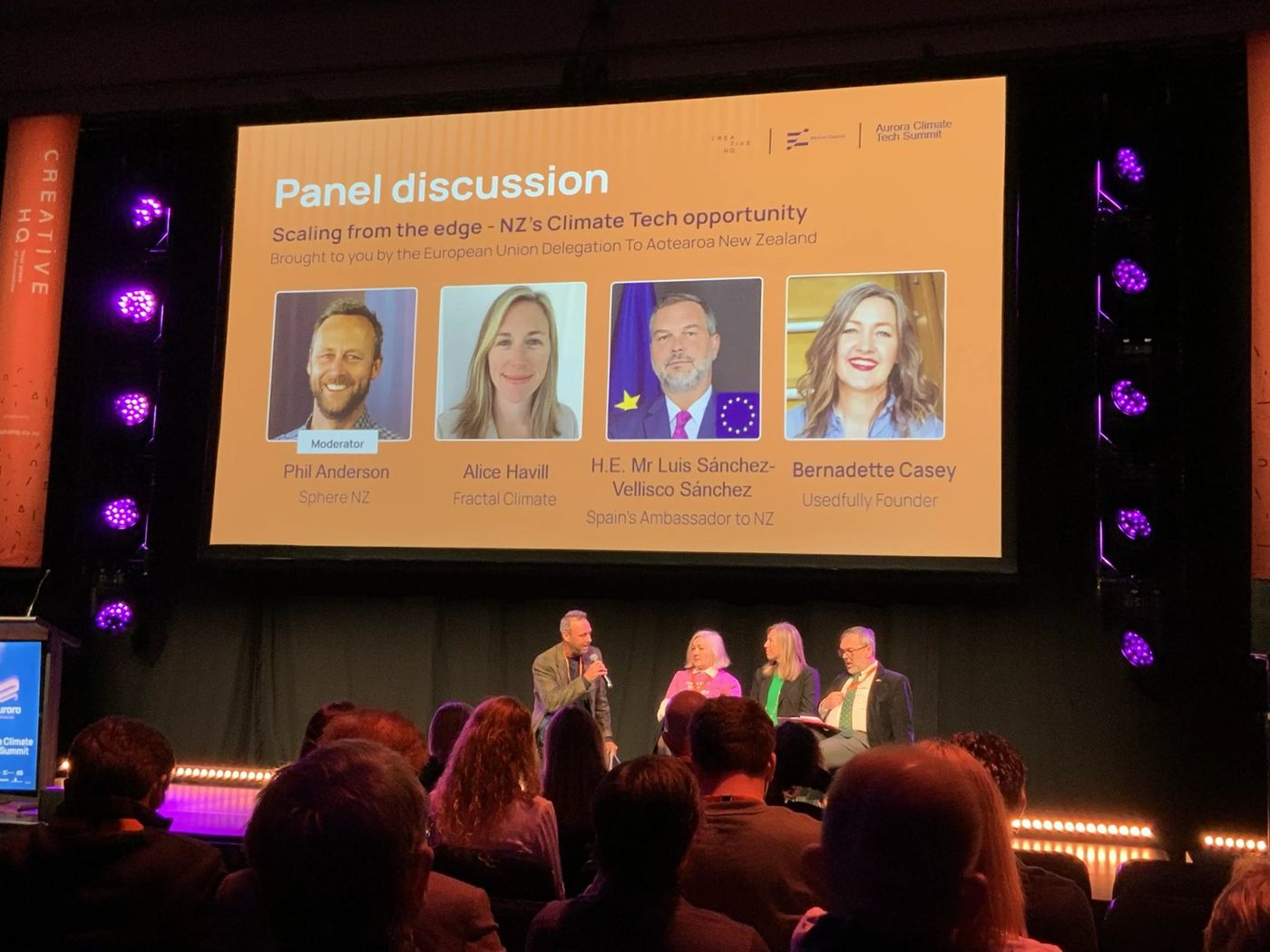
“Scaling from the Edge” — Phil Anderson, Alice Havill, the Ambassador of Spain and Bernadette Casey.
The world came to Wellington, too. Phil Anderson introduced Sphere, the new outfit built to help Kiwi companies go global, and chaired a candid panel on scaling from the edge with Bernadette Casey of textile-cleantech company Usefully. The European Union delegation and the Spanish Ambassador to New Zealand spoke to the EU–NZ Free Trade Agreement, Horizon Europe and the clean-tech doors now open to New Zealand companies. The result is a genuinely, nationally differentiated event — practical, connected, and built to put the technology, the capital and the policymakers under a single roof.
Why this matters for ASL
The summit's deployment thesis is our thesis. With our Bioenergy Resource Recovery Plant at Bell Island in Nelson — government-backed, consented and under contract, on the path to commercial operation — and a pipeline behind it, we're built to make exactly that move from pilot to industrial scale: the bridge the summit identified as the sector's missing link. We treat what most of the world still calls “waste” as what we've always known it to be: unconventional gold.
“We're very good at inventing world-class solutions. Where we lose ground is deploying them at the scale the moment demands. Closing that gap — turning pilots into infrastructure — is the work of the next decade.”
That trajectory is being recognised. We're the GSA Oceania Regional Winner for Best Greentech Startup, we're government-backed, and we've just been named one of the Top 100 Resilience Solution Providers in the 2026 QBE AcceliCITY Resilience Challenge — a six-month global accelerator run by Leading Cities and powered by the QBE Foundation, selected from applicants across 70-plus countries. Earlier, at the Orion Energy Accelerator, we took both the Orion Impact Award and the EY People's Choice Award. Those awards came with real prize value — but their lasting worth is as credentials: external validation of who we are and what people believe we're capable of.
The real value of a cohort
If there's one thing we'd pass on to founders weighing up a programme like Aurora, it's this: the grant gets you in the door, but it isn't the prize. For us — a graduate of the Climate Response Accelerator 2022/23 — the real benefit was relationships. The programme let us deepen our relationship with Motion Capital significantly, and that relationship has been central to moving ASL forward.
We particularly like the way Motion has evolved the programme for this year's cohort — deepening engagement through SAFE notes. That's a significant and genuinely new step forward, aligning the programme with its founders well beyond the accelerator itself.
Thank you
Turning a climate conference into something this ambitious takes a coalition. Our thanks and congratulations to Creative HQ, Motion Capital, Uush, Sprout People and everyone who organised, sponsored and built the day. For one day, the technology, the capital and the policymakers were all in the same room. That's exactly what this sector needs — and exactly the momentum we intend to carry forward.
Were you in the room and we didn't get to finish a conversation? We'd love to pick it up.
Get in touch →Photos: Alimentary Systems — Aurora Climate Tech Summit 2026, Wellington.
Series · Aurora Climate Tech Summit 2026
- 1. Under One Roof: The Aurora Climate Tech Summit 2026 — you are here
- 2. "Bring the world to New Zealand": Alice Havill's challenge to Aotearoa's climate-tech founders
- 3. From ambition to adoption: what five parties actually said about climate tech
- 4. The $30 billion circle: inside the bioeconomy breakout
- 5. Scaling from the edge: how Kiwi climate companies actually get into Europe
- 6. What global investors actually look for: inside the international investor panel
Free download
Aurora Climate Tech Summit — Founder Field Notes
One tight page per talk: the key points and the standout quotes, distilled for founders. No sign-up.