The day ended with the session everyone had been waiting for: a cross-party political forum, "From ambition to adoption — Climate Tech & New Zealand's net zero pathway," moderated by Newsroom's Marc Daalder. Five parties were represented — and, worth noting because the printed programme listed only four, National's Grant McCallum joined partway through, alongside Labour's Hon Megan Woods, the Green Party's Scott Willis, TOP's Qiulae Wong and NZ First's Dr David Wilson.
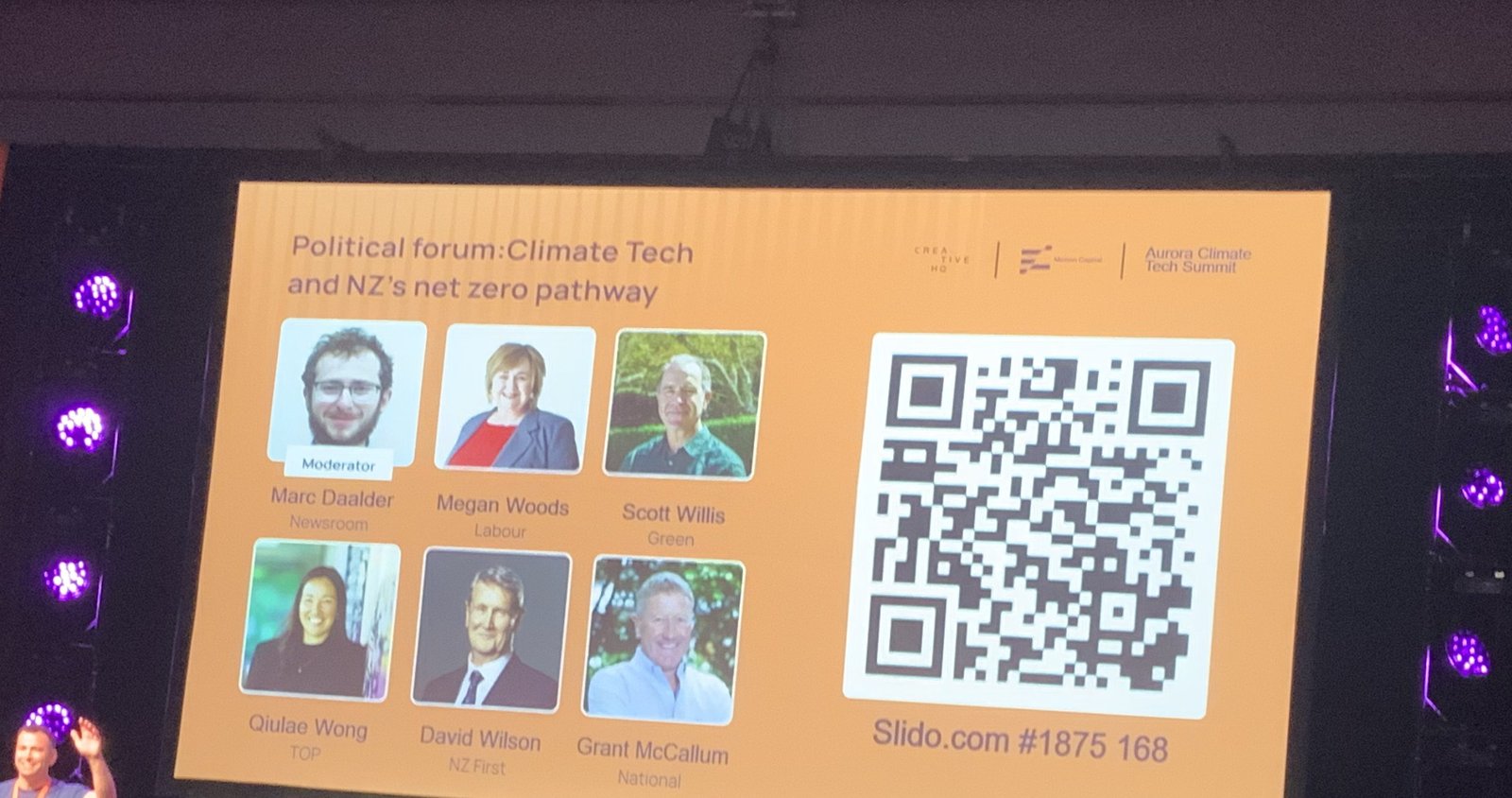
The line-up: moderator Marc Daalder (Newsroom) with Megan Woods (Labour), Scott Willis (Green), Qiulae Wong (TOP), David Wilson (NZ First) and Grant McCallum (National).
What lifted it above the usual pre-election shadow-boxing was that it stayed concrete. Over an hour the panel worked through the innovation and capital system, energy, and the bioeconomy, then took live audience questions. Because this is the session our readers most wanted captured in full, we've written it up at length — theme by theme, in the panellists' own words as far as possible.
The starting consensus was real: every party agreed New Zealand is missing an opportunity. Where they split — sharply and usefully — was on why, and on which lever to pull first.
The diagnosis: "walking backwards" or a failure of capital and stability?
The Greens' Scott Willis, the party's energy spokesperson, opened with the bluntest framing of the day. "We are walking backwards as a nation," he said. "We are trying to import LNG. We've just opened up oil and gas exploration. We've got a government in full climate denial." The problem for clean tech, in his telling, is that "so many have failed to scale or have had to go overseas because there hasn't been that support… that co-investment." But the potential, he said, was visible in the room: "homes that are mini power stations connected to electric transport," regenerative agriculture "building value rather than volume in our food and fibre systems," and a simple question of choices — "why wouldn't you want to get on a train or an electric bike to travel the country rather than simply get into a Ford Ranger?" What was missing, he argued, was the political will "to make it possible for an ecosystem to emerge with government support, risk sharing."
TOP's Qiulae Wong, who described herself as "relatively new to politics" after a career "in a similar field to many of you," diagnosed it differently — as a failure of capital and consistency. She praised the founders who had pitched earlier for being "short, succinct, following the evidence," and suggested politicians "could learn a lot from that." Then the substance: "There's not enough of our private domestic capital going into these amazing businesses because it's all locked up in property, and there isn't enough government investment either. We pride ourselves on being a nation of innovators, and yet our investment in R&D and science is one of the lowest in the OECD." Her second theme became a refrain for the whole panel: "If we keep flip-flopping on what direction we are going… then we are hamstringing so many of the brilliant ideas in here from scaling up."
What we'd copy from the rest of the world
Daalder asked each panellist what they'd most like to replicate from overseas — "in outcome, if not an exact policy."
NZ First's Dr David Wilson, drawing on "20 years… in economic development and regional economic development," pointed to Smart Specialisation, a programme he'd seen work across the OECD and Scandinavia. Rather than New Zealand's "broad brush" 15% R&D tax rebate, he argued for concentrating government effort "region by region and sector by sector" on the country's genuine competitive advantages — "shifting some of the money and how it's spent already in government, and channelling it towards those kinds of advantages."
Labour's Megan Woods pushed back on the idea of a single silver bullet. "New Zealand will always compare itself to a basket of countries — fast-growing small economies: Singapore, Scandinavian countries, Ireland," she said. Attracting international R&D investment, she argued, depends on matching what competitors offer — "having that R&D tax credit… that we brought in as a government" — but also on the state having "some skin in the game," through grant funding, equity, and clear signals of national priority. She made a spirited defence of curiosity-driven research: "We do need to let a thousand flowers bloom… It's not for politicians to decide this is the one area we're going to specialise in." No one, she noted, could have written a grant application predicting the spin-offs of the space programme. But she embraced the language of missions — "Kennedy called it a moonshot" — as a way to give scientists a shared national purpose.
Willis reinforced the point with his own experience of foundational science, from nine months at France's INRA agricultural research institute in Dijon. Their mission, he recalled, was shifting intensive agriculture toward "a more regenerative biological system" to tackle the nitrate problem behind blue-baby syndrome and elevated cancer rates. His warning was pointed: "It's all very well saying we need to commercialise research, but if we're not doing the foundational stuff, we won't have anything to commercialise in a very few years."
Wong closed the round on the theme she'd return to repeatedly — durability. The common thread among Ireland, Denmark and Singapore, she argued, "is that long-term vision and sticking to it." Her example: "If you take Denmark… they've gone from 5% of their electricity from renewable generation to now over 90% over the last 30 years. You can't achieve that if you have people squabbling and making that a political football."
The "missing middle": the $20 million wall
Daalder then named a problem every founder in the room knew intimately: New Zealand climate-tech companies can raise up to roughly $20 million locally, but beyond that "they start to run into difficulty" — a capital and infrastructure gap.
Wong tied it back to the national R&D spend: lift investment "from 1.5%, where we are now, to about 2% of GDP at least, ideally getting to three," with a chunk directed at the organisations — "the likes of KiwiNet and the Product Accelerator" — that help commercialise ideas at home "otherwise they do go offshore."
McCallum arrived at this point — apologising for lateness because National had "just announced the signing of a $3.649 billion PPP for the Northern Expressway," a big deal for him as a local MP. Daalder welcomed him with a dry aside about there being only five microphones to share, "and we won't take it as any indication of a future coalition."
Willis returned to risk-sharing and told a cautionary tale from his own past running a peer-to-peer electricity network: "The little company that set that up lost millions because we weren't able to share electricity at that time — the settings were not right — and all that IP has now floundered." Government, he argued, needs to invest "to stop the flow out to other countries, the sale-off of good ideas, and the failure."
Woods argued the first $20 million is "something that New Zealand has got better at" — the harder question is how companies "at the bottom of the world present themselves as a really good proposition" in a world "awash with capital." Part of the answer is stability and government backing "not necessarily writing the cheques" — she cited taking hydrogen companies to Japan on a ministerial trade mission, several of whom secured funding as a result. And she pitched Labour's headline policy: "a future fund here in New Zealand… investing in our sovereign future," so returns flow back home "to build more of these roads, these hospitals, these schools."
Wilson welcomed the idea with a jab — "we appreciate Labour following with the Super Fund; we'll rename it the Future Fund for you" — and raised the stakes to "$100 billion… $200 billion." He offered a concrete success story for catalytic public funding: a small Provincial Growth Fund investment in CODE, Dunedin's Centre of Digital Excellence, seeded a gaming sector that has "just gone past the $1 billion turnover" a decade later, including Wellington's PikPok with "270-odd employees." His structural point: "The private equity layer is quite thin here in New Zealand," and — directed at the founders — "we want you to stay. We don't want you to leave to find that finance."
McCallum pointed to Invest New Zealand, which "actively goes out to source capital," led by Todd McClay, plus $40 million into research and the market access that trade deals (an India FTA, the EU FTA) open up: "You also need to offer a market… that's a really important part of the whole invest picture."
"Used here first": will parties back New Zealand innovators?
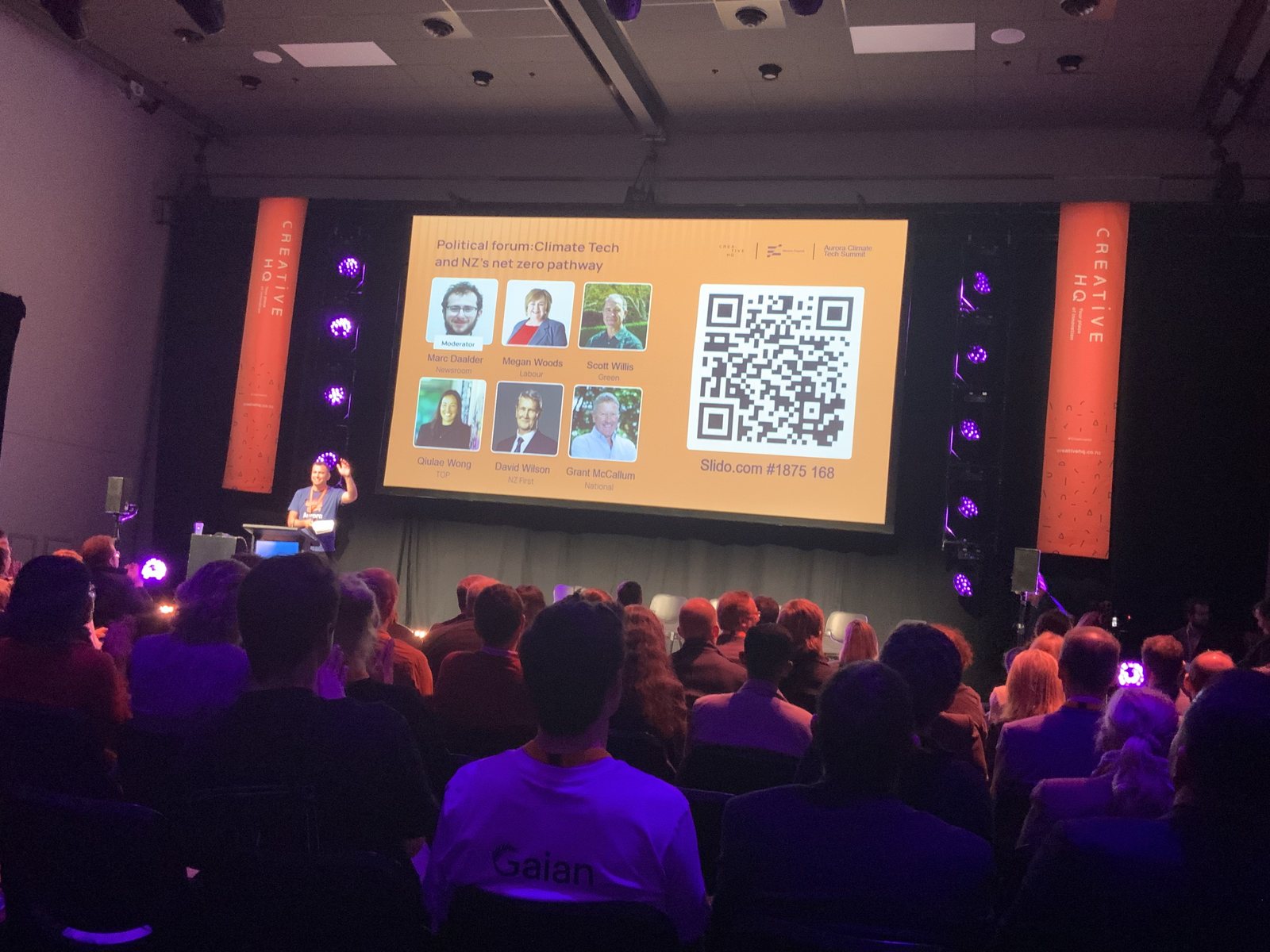
Five parties, one stage: (from the audience's left) Marc Daalder moderating, with Woods, Willis, Wong, Wilson and McCallum, and the Slido question board behind them.
The sharpest, most practical exchange came from an audience question out of the energy breakout, which Daalder broadened: How will your party back New Zealand innovators to ensure our products are used here first, to enable overseas success later?
McCallum reached for agriculture, where "we're recognised as being world leaders," citing AgriZero — "the government's invested $400 million over four years" — as the model of backing a sector "where we have expertise" and then taking it to the world "because we are recognised as a reputation for doing things well with high standards."
Wong argued for "local economic resilience" amid global volatility, and for "the restoration of funding to our polytechs as a regional hub for economic development" — the places, she said, where many of these businesses are born and where domestic markets for their products can be built.
Willis answered from energy but broadened it: "Our approach to energy is not think big; it's think distributed." That means local area energy planning, "biomass, biogas for those industries that are really hard to electrify," and keeping "the energy dollar in local circulation" through the distribution networks that "understand their communities."
Woods offered what she conceded was "not probably the sexiest policy": procurement. "There is a saying: no one got fired for hiring IBM — and that actually stifles the innovation in governments procuring locally." The fix, she argued, is in the cost-benefit analysis behind every Cabinet paper: "not the least-cost option, but… the flow-on benefits of giving that market share to a local company," building on the social-procurement programme Labour began in government.
Wilson agreed emphatically on local procurement and "value for money… because local suppliers can provide better long-term outcomes, especially if it's infrastructure." He used the moment to lay out NZ First's energy-structure policy — "splitting the gen-tailers" into generation and retail, keeping generation and distribution in public hands and leaving retail to the market — on the premise that "the single most important thing New Zealand can do is have long-term, reliable, sustainable energy at a cheaper rate. Show me a country in the world that survives on expensive energy and is prosperous." He also acknowledged that industry "still need[s] gas for high heat."
That prompted the day's most pointed one-liner, from Willis to Wilson: "If you want to split the gen-tailers, I have a bill in the biscuit tin. It's called the Electricity Industry Separation of Generation and Retail Businesses Amendment Bill… if you want to do it, why wait for an election?"
Can New Zealand have a durable energy strategy?
Daalder asked for a show of hands on whether the panel supported a long-term, politically durable energy strategy — then put the harder question: if a strategy written by Grant McCallum would differ from one written by Megan Woods, and it changes every few years, is it useful?
Woods argued durability can't come from politicians alone: "The pressure has to come from outside… a broad church that can bring pressure on all parts of this political spectrum. That's what we saw with the net-zero bill" — environmental NGOs joining with big businesses. She revealed that a broadly devised energy strategy "has been sitting on the minister's desk… since 2023," and that "a conscious decision has been made not to progress that piece of work… to the detriment of us as a country."
Wilson used his time to stake out NZ First's "climate realist" position and to throw down two engineering challenges to the room. On shipping: "If you went to Denmark and you work for Maersk… they run their ships on diesel. And we export on ships." Batteries won't work — "they're too heavy" — so he pointed to methanol trials and asked founders for "some other form of fuel that could power those huge ships." On wind: turbine blades are "resin and fibreglass and carbon fibre… sitting on steel-infused concrete — can you please provide us some solutions?" He nodded approvingly at an earlier presenter — "the fungi lady… coming up with some really cool alternatives in terms of resins and binding agents" — and at wood-based resins as "an opportunity for a country that produces a lot of wood."
Willis said an energy strategy "would be preferable to the ad-hocism that we're dealing with," and returned to the Zero Carbon Act as the template — it "emerged with the support of NGOs and of the general public… that real public push to make it unacceptable for every party, bar one, to disagree with it." He said he'd repeatedly offered to work with Minister Simeon Brown on a national energy strategy and been refused, and insisted such a strategy "needs to be something that is owned collectively… owned in the public, and that way, when politicians change, the energy strategy will endure." His evidence that the shift is already bigger than politics: Southland farmers, hit by a 2024 storm that knocked out power for three weeks, "are now investing in… batteries and solar because they can't afford to not have the power when they need it."
Wong called for leadership over waiting on the public — "if our politicians are waiting for the public to tell them to do this stuff, we'll be too late" — plus a single Ministry of Energy and a single regulator to replace today's fragmented arrangements, and a policy to "ring-fence the crown dividends from the gentailers" as capital for whatever the strategy's current priority is.
McCallum defended the government's record: fast-track consenting had unblocked renewable build — "we've got plenty of it in this country" — but emissions had gone backwards because "we were burning a lot of coal" for the firming capacity that earlier governments hadn't secured. His bottom line for investors was certainty: "The lights have to stay on… industry need certainty of energy supply and price," which is why, "whether we like it or not, we all still rely on those carbon… fossil-fuel sources" for firming. His warning cut at his rivals: "when you've got different parties saying they're going to walk in and cancel contracts with people who do investing, that doesn't help either."
The bioeconomy and the 6,000 native species
Finally, Daalder carried across the question that had drawn the most support in the morning's bioeconomy breakout: we focus a lot on forestry and exotic pine — what support can be rallied to unlock bioeconomy value from our 6,000 endemic native species?
Wilson answered with a concrete example: during the Provincial Growth Fund, "we provided 30,000 seedlings of kauri to Ngāti Rehia in the far north," primarily to address kauri dieback. The seedlings are now growing and being underplanted by the hapū, opening opportunities in "biotourism and native tourism and cultural tourism." He'd also explored commercial stands of tōtara with Scion while running Northland Inc. His organising principle: "If you cultivate these species, that actually gives you an opportunity to make sure that we're protecting them along the way — so it's kind of a win-win."
Woods returned to the unglamorous plumbing of climate policy: "We've actually got to make sure we've got some very boring things like the look-up tables right." Forestry, she argued, is still trapped in a "Kyoto Protocol kind of way" that only counts traditional blocks — excluding, for example, "linear riparian planting… that has multiple benefits." The goal should be "the right plant in the right place" on marginal land, with the ETS and permanent-forest settings adjusted to reward the water-quality and slope-stability gains natives deliver.
Willis widened the lens beyond trees: "We have an incredible wealth in Mātauranga Māori that we can take advantage of," alongside "the wealth of our sheep… food and fibre," and geothermal minerals "that are at the moment mostly wasted." Making smarter, cleaner use of all of it, he said, is "part of our purpose in our green industrial strategy."
Wong tied the bioeconomy back to TOP's tax platform: fix the ETS settings, introduce "a land tax and a citizens' income" that exempts private conservation land to incentivise wetlands and biodiversity, and build "a biodiversity credit market" so "our innovators and our farmers can be working together… delivering climate resilience at the same time. Huge opportunity for New Zealand."
McCallum pointed to what farmers already do voluntarily — native bush "being fenced off voluntarily by the farming community" through QEII covenants, and pest control across "all this huge conservation estate." Do that well, he said, "and you get a healthier forest, more carbon sinks, and be able to measure that" — working with private landowners rather than taxing them.
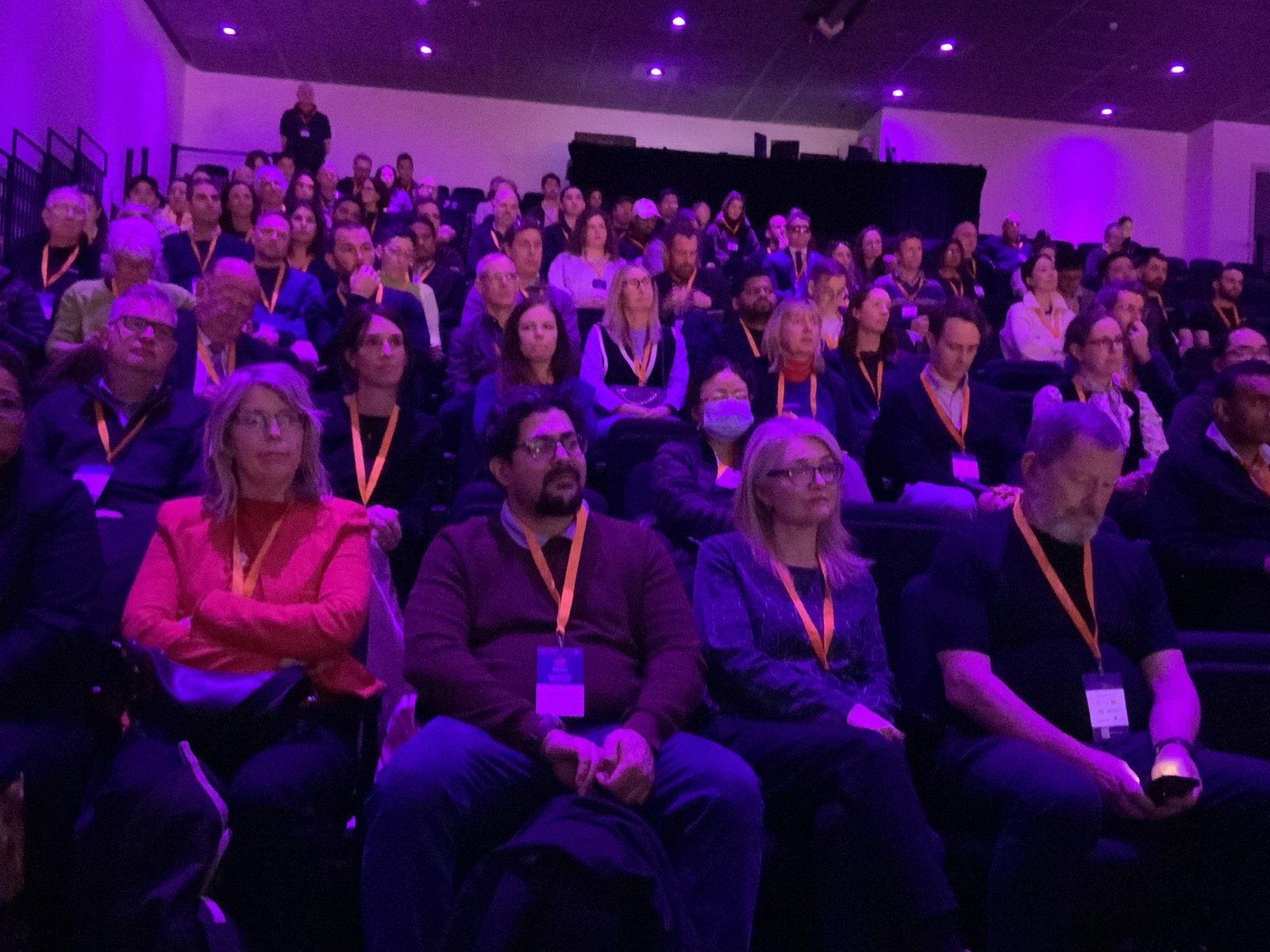
The forum drew a full house — the technology, the capital and the policymakers under one roof.
The audience's turn
Daalder closed with rapid-fire audience questions and a 45-second limit.
On early-stage support — given Invest NZ and NZTE no longer support startups raising under $10 million or with under $1 million in ARR: Willis offered "public-private partnerships, risk-sharing, green bonds"; Wong, "more funding into those startup ecosystems and incubators" plus unlocking private capital via a land tax; McCallum, using the R&D refund to seed startups toward "the bigger money from overseas"; Woods, rebuilding innovation's place "in a post-Callaghan world" and, again, the Future Fund. Wilson urged everyone to "raise your sights a little higher — $200 million is not going to get us very far," and zeroed in on the cost of capital: New Zealand's four major banks hold "85 to 90 percent" of banking, and the country "pays one of the highest net interest margins in the world" — roughly "1% too much," which on a mortgage "is $70,500 a year that you don't have." Lowering the cost of capital, he argued, is the real lever.
On science funding — with fundamental research seen as valued only if it can be commercialised: Woods would "return the Marsden Fund to… support basic and fundamental research"; McCallum cited $40 million already committed; Willis warned the science reforms had been "unfunded" and that commercialisation "shouldn't be a pipeline for IP to the private sector, unless there are real climate and social-justice tests," adding, "let's think about a decarbonisation mission." Wilson backed basic science "as long as it's not whale song," preferring targeted work — paying Ngāti Rehia to tackle kauri dieback — organised around "a few tight… missions." Woods defended curiosity-led funding: "researchers decide… not [being] measured by the business case that sits in there — that's what happens when a country backs fundamental research."
On KiwiSaver — over $10 billion flows in annually, but less than 1% reaches New Zealand venture or private equity. Woods pointed again to the Future Fund as the vehicle a politician can legitimately direct, since KiwiSaver allocations aren't something "a politician [can] really influence."
For founders
Field notes: what a founder should take away
- Everyone agrees the resource is under-monetised — the fight is over the lever. Match your ask to the party: procurement (Labour), splitting gen-tailers + lowering the cost of capital (NZ First), distributed energy and biogas for hard-to-electrify industry (Greens), a biodiversity credit market + conservation land-tax exemption (TOP), measurable native-forest carbon on private land (National).
- The "missing middle" ($20m wall) is recognised across the House — Labour's Future Fund, NZ First on the cost of capital and net interest margin, TOP's push to lift R&D to 2–3% of GDP.
- ETS and forestry "look-up tables" are in play. Whether riparian and native planting count is being actively debated — relevant to anyone touching land, carbon or biomass.
- Procurement is a real route to market. "No one got fired for hiring IBM" — but Labour and NZ First both argued for weighting local flow-on benefits in government CBAs.
- NZ First's open challenges to founders: low-carbon fuels for shipping (methanol), recyclable or bio-based wind-turbine blade materials, and wood-based resins.
- Durable policy needs outside pressure, not just politicians — the Zero Carbon Act (NGOs + big business) is the template every party referenced.
Series · Aurora Climate Tech Summit 2026
- 1. Under One Roof: The Aurora Climate Tech Summit 2026
- 2. "Bring the world to New Zealand": Alice Havill's challenge to Aotearoa's climate-tech founders
- 3. From ambition to adoption: what five parties actually said about climate tech — you are here
- 4. The $30 billion circle: inside the bioeconomy breakout
- 5. Scaling from the edge: how Kiwi climate companies actually get into Europe
- 6. What global investors actually look for: inside the international investor panel
← Previous: "Bring the world to New Zealand": Alice Havill's challenge to Aotearoa's climate-tech founders Next: The $30 billion circle: inside the bioeconomy breakout →
Free download
Aurora Climate Tech Summit — Founder Field Notes
One tight page per talk: the key points and the standout quotes, distilled for founders. No sign-up.