
The single most clarifying slide at the Taranaki Energy Futures Forum came from Evelien Wallace, a petroleum exploration geologist who currently does not have a job and is making more progress on geoheat than most funded programmes. Her image was of a single tool being replaced by a multi-tool — and it explains, better than most policy analysis, why the energy transition feels so much harder than the arithmetic suggests it should.
Her breakdown was simple. Personal vehicles used to be petrol; now they are electrified. Heavy vehicles used to be diesel; now they are hydrogen, or dual-fuel, or something not yet settled. Aviation used to be jet fuel; now it is sustainable aviation fuel. Low to moderate industrial and agricultural heat used to be gas or coal; now it might be a hybrid of geoheat, electricity and biomass. High industrial heat used to be gas or coal; now it might be hydrogen or biogas.
One input became six. Every energy need now requires a bespoke solution, and each of those solutions has its own supply chain, its own capital cycle, its own regulatory pathway and its own set of people who understand it. That is the transition. Not a substitution — a fragmentation.
We are not replacing a fuel. We are replacing a fuel with a toolbox, and every tool in it needs its own supply chain, its own consent pathway and its own experts.
The afternoon innovator session is worth dwelling on, because it was the part of the day where the toolbox was actually laid out on the table. Five presentations, five very different technologies, and a pattern running underneath all of them that matters more than any individual pitch.
Geoheat: the resource under a region that has already drilled the holes
Evelien's argument for Taranaki geoheat rests on an unusual competitive advantage. Geothermal heat, as distinct from the high-temperature geothermal of the Taupō Volcanic Zone, is warm rather than hot — useful directly, but not for generating electricity. In Taranaki that means roughly 30 degrees at 400 to 500 metres, and around 80 degrees at 2,000 metres in the north. Solid rather than spectacular.
The point of difference is not the heat. It is the holes. Taranaki has drilled a great many wells and has a remarkably well-mapped subsurface geology. Other regions may be warmer, but they do not know where their aquifers are, how much water they flow, what temperature they sit at, or what permeability they have — and those are precisely the variables you need to understand before anyone will fund a well. Taranaki knows.
She walked through three development pathways: recompleting existing petroleum wells for geoheat, co-producing heat from the hot water that oil and gas operations already bring to surface, and greenfield drilling informed by the existing subsurface picture. She was honest that the first is probably not commercially viable yet but worth testing.
The international precedent is strong. In the West Netherlands basin, a mature petroleum province with abundant data, expertise and a need for decarbonised heat, operators went back to the legacy well logs and stood up geoheat wells targeting the same reservoirs — gas at the structural highs, warm water at the structural lows. The result is miles of glasshouses producing food using the heat and the CO₂. In Swan Hills in Canada, a mature oilfield producing warm water stood up an organic Rankine cycle plant to generate electricity from it. Her observation was that as a petroleum field declines you could produce progressively more geoheat, extending the commercial tail of an asset whose hole has already been paid for.
And New Zealand has a precedent nobody thinks about. Hanmer Springs is built on a failed petroleum well from 1909 that hit hot water instead. It is still going, and it is close to globally unique.
Evelien Wallace’s multi-tool, set out in full. Every energy need now requires a bespoke solution, and each one carries its own supply chain, capital cycle and consent pathway.
The lesson from Evelien’s talk is that geoheat and biogas are natural neighbours rather than competitors. Geoheat provides a constant base heat load. Biogas provides dispatchable high-grade heat. Her own slide made the point: start with a baseline heat source at 60 or 80 degrees and put an electric heat pump on top, and the whole system becomes dramatically more efficient than heating from ambient. An industrial site with a geoheat base, a biogas peak and an electric heat pump bridging the two is a far better decarbonisation story than any one of those technologies alone.
Her closing line — give her money so she can do it — got the laugh it deserved and also happens to be the accurate summary of where a great deal of promising New Zealand energy work currently sits.
Hydrogen: the molecules argument
Amelia Renzios of Hiringa Energy made a point that gets lost in most transition conversations. There is enormous focus on the electrons, she said, and comparatively little on the molecules — when in fact a great deal of decarbonisation depends on molecules that electricity cannot directly replace.
The Kapuni project is the demonstration. Four wind turbines totalling 24 megawatts, generating power for five megawatts of electrolysis, producing hydrogen that displaces fossil-derived hydrogen in Ballance's urea plant. She called it a power-to-X project: using hydrogen to decarbonise a feedstock rather than a fuel. The joint venture spans Ballance, Todd, Parininihi ki Waitōtara and MBIE, with close work alongside Ngāruahine and neighbouring iwi.
The construction detail was the part the room enjoyed. Turbine foundations 24 metres across and three metres deep. Blades among the largest in the country, landing at Port Taranaki and moving to site overnight to spare everyone the experience of following a blade transporter to work. Commissioning targeted for May 2027.
But the detail that mattered most was organisational. Of roughly forty-five people at Hiringa, about twenty came out of Taranaki oil and gas. She was explicit that this is not charity — those are simply very good skills, because the Taranaki energy industry is the best place in the country to learn how to solve complex problems in fast-moving environments. And they are fabricating 40-metre ammonia storage vessels for their Australian project in a Taranaki workshop, then shipping them out.
That is the reindustrialisation argument in physical form. The capability did not need to be created. It needed to be redirected.
Proving things at small scale, on purpose
Tom Wiseman and Ellie Hills from Total Instrument Services gave the presentation that stays with you longest, and theirs was the least glamorous of the five. Tom is a fellow MOA accelerator alumnus, so we came in already knowing how the company thinks. The way he put it on stage was still sharper than anything we could have paraphrased.
The company started in 2006 as a small instrument and electrical firm in what was then mostly paddocks at Bell Block, supporting Todd sites around the region. That model worked well for about a decade. Then the oil and gas landscape changed, Tom bought in two weeks before the first COVID lockdown, and everything since has been ups and downs.
What they did with that is the interesting part. Rather than waiting for new industry to replace the old pathways, they built their own. A rebrand to reflect work beyond the region. ISO accreditation for quality and for health and safety, so they could step onto any site in the country or overseas. A metrology calibration lab to international standards. A dedicated hydrogen arm, H2X. Rooftop solar commissioned this year, now producing green hydrogen on site. Battery storage going in. And their own microgeneration retail platform.
Their method for evaluating an idea is worth recommending to every organisation stuck in a feasibility loop. Somebody suggests something. The team sits around a table and asks how they would prove it. They go round the corner for parts, build it inside about a week, and then they know whether it works.
Ellie was clear-eyed about the scale. It is small, and that is deliberate: it proves the concept, it is immediately commercialisable, it uses skills they already have, and critically it gives apprentices somewhere to learn now that the traditional pathway into the big operators has closed. Tom framed the whole thing as taking back some control over what happens next rather than waiting to see what arrives.
Every organisation at that forum which had moved fast had done the same thing. They had reduced the cost of being wrong, so they could afford to find out.
The 600 per cent argument
Will Thorp of Kākāriki Renewables put the most provocative number of the day on the screen. New Zealand's renewable energy target, he argued, should not be 100 per cent of electricity supply. It should be around 600 per cent.
The reasoning: three times current energy makes the country genuinely self-sufficient, which matters more each year that geopolitical uncertainty tightens supply chains. The remaining multiple goes into wealth-generating industry. He showed the correlation between energy production per capita and economic wellbeing, and made the case that the country should be moving up that axis — partly by generating more, and partly by being smarter with what it generates, which is how you rise above the trend line rather than merely travelling along it.
He also put up the gas production forecast published by his colleague Brett Rogers, showing the step down in 2027 as the Maui field closes, and the divergence between the optimistic exponential decay curve and the more realistic straight-line curve informed by field dynamics. The conclusion is uncomfortable and correct: the energy has to be replaced, and the replacement has to be under construction now rather than under consideration.
Kākāriki's phase one portfolio exceeds three gigawatts of combined generation capacity. Will was candid that not all of it will progress at the same pace, and that storage will be essential to integrating projects with the grid without curtailment. Their development principles put genuine partnership with mana whenua at the centre, and they run complementary land use alongside generation — including a sheep and dairy agrisolar trial at one project. He mentioned that a recent open day for a wind farm ended with neighbouring landowners asking to have turbines on their own properties, which is not the usual outcome of a wind farm open day.
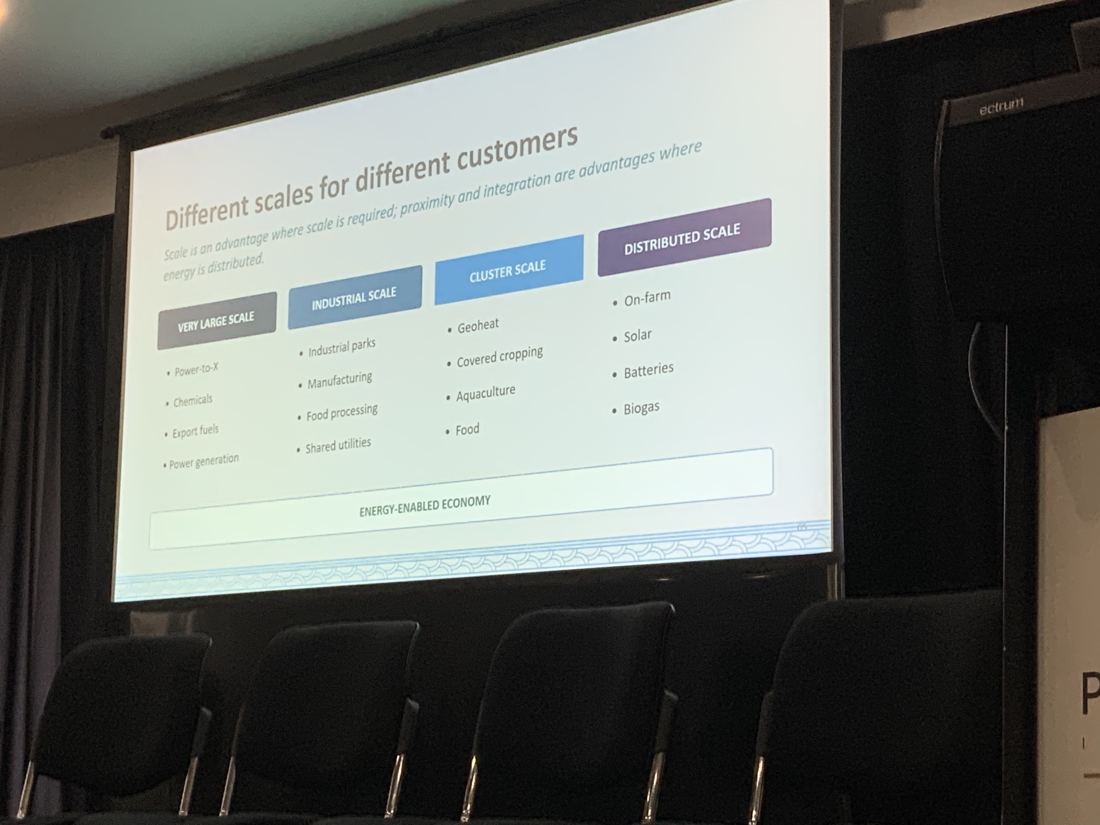
Scale is an advantage only where scale is required. Geoheat, covered cropping and aquaculture sit at cluster scale; biogas, solar and batteries at distributed scale. A useful corrective to the assumption that bigger is always the answer.
Where a BRRP sits in the toolbox
Here is the thing about Evelien’s multi-tool image that the room under-appreciated. If the transition fragments a single fuel into six solutions, then the technologies that do more than one job at once become disproportionately valuable — because each one you deploy collapses several of the six problems into a single piece of infrastructure.
A Bioenergy Resource Recovery Plant is one of those. It takes sewage sludge and organic waste — a disposal problem — and produces biogas for high-grade industrial heat or grid injection, biofertiliser that returns nutrients to local land, and verified carbon reduction. One asset. Four problems: waste, energy, nutrients and emissions.
It also sits well next to everything else described that afternoon. Geoheat supplies base heat and biogas supplies the peak. Hydrogen electrolysis needs constant renewable input and biogas is dispatchable rather than intermittent. Digester CO₂ feeds glasshouses, which is exactly the use case the West Netherlands basin built its geoheat industry around. And every one of these technologies benefits from being co-located inside an energy precinct, which is precisely why Taranaki Regional Council's precinct work matters so much.
None of that is a claim that biogas is the answer. Evelien's framing is right and the honest position is that there is no single answer any more. What there is instead is a set of tools that work considerably better in combination than in isolation, and a region that has, unusually, got most of them in one place.
How the tools stack. A geoheat base, a heat pump bridging, and dispatchable biogas at the peak beats any one of the three deployed alone.
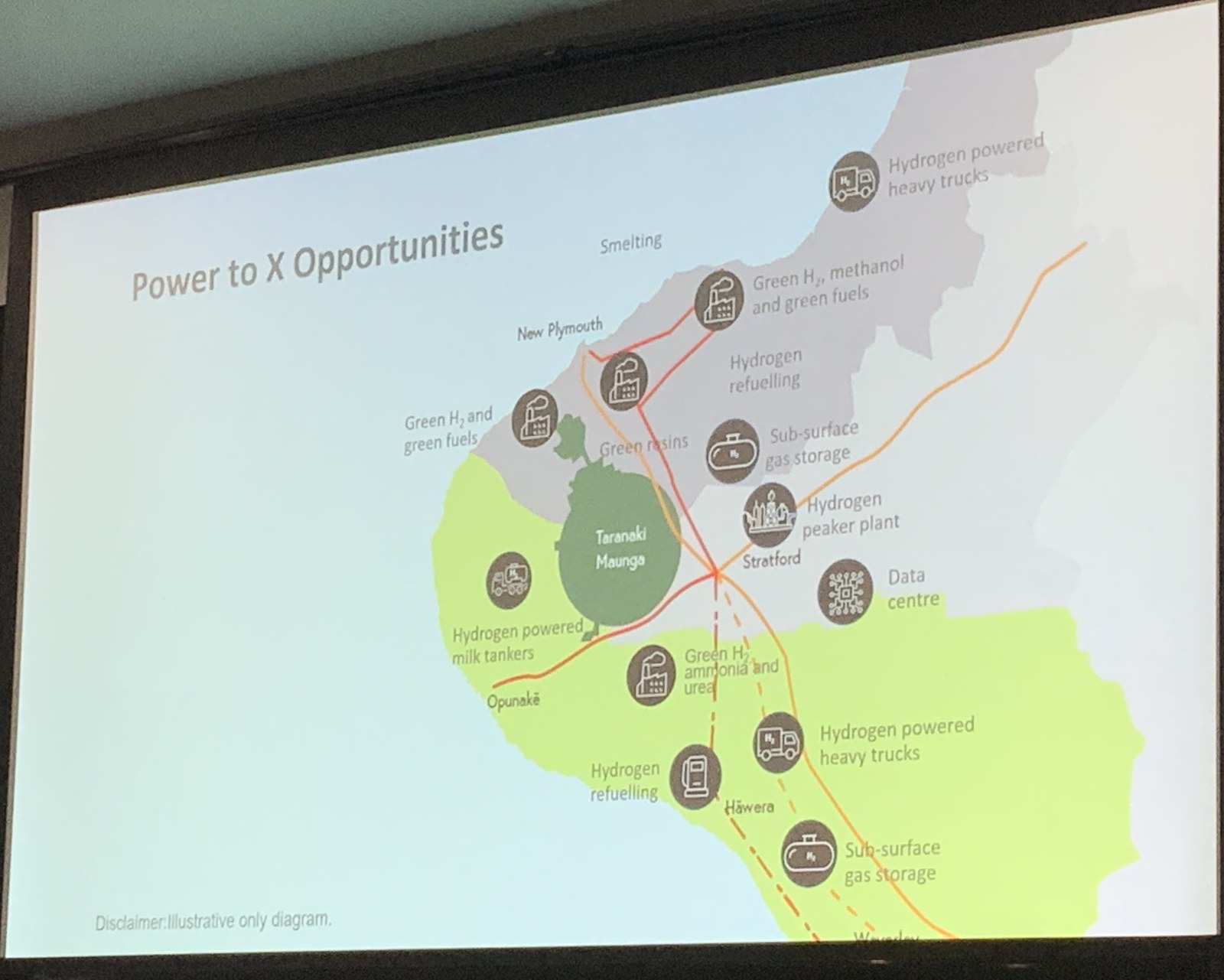
Hiringa’s power-to-X map: green hydrogen, methanol, ammonia and urea, sub-surface gas storage, a hydrogen peaker, a data centre, refuelling, and hydrogen-powered milk tankers. Marked illustrative only — but it is the clearest picture anyone showed of the molecules half of the transition.
The pattern underneath all five
Watching those five presentations back to back, the common thread was not technology. It was posture.
Every one of them was building something at a scale they could afford to be wrong about. Evelien is measuring water temperatures in council bores and talking farmers into letting her poke a thermometer into the ground — and she found 60 degrees at 40 metres in a Lepperton water well, which nobody was looking for because nobody had thought to check. Tom and Ellie build prototypes in a week. Hiringa took years to reach a final investment decision on Kapuni and used the time to build the partnerships that made it survivable. Will's portfolio is deliberately broad so that individual projects can move at different speeds without stalling the whole programme. Daniel Gnoth, presenting the bioenergy feedstock modelling, told the room directly to keep piloting in order to de-risk, because there is a great deal to be learned by doing.
The contrast with the morning session was stark. The morning was full of talk about strategy, alignment and who should convene whom. The afternoon was full of people who had stopped waiting.
Iain Hosie of the Taranaki Applied Innovation Centre put the structural problem in one statistic: around half a per cent of New Zealand venture capital reaches the regions. His answer is an innovation precinct at Trojan House with shared labs and shared capital equipment, so that a startup does not have to buy the same kit as every other startup before it can find out whether its idea works. His quote of the day, borrowed from Sean Simpson, was that in these places knowledge travels at the speed of beer.
That is the same insight as Tom's week-long prototype and Evelien's borrowed thermometer, expressed as institutional design. Lower the cost of finding out and more things get found out.
What we take from it
ASL is not a hydrogen company or a geothermal company, and we are not competing with anybody who presented that afternoon. We process waste that already exists, at sites councils already own, using biology that has been proven for decades. The process is modelled on bovine digestion, which is about as thoroughly field-tested as engineering references get.
But the reason we spend our time at events like this is that the toolbox only works if the tools know about each other. A geoheat developer who does not know a digester could supply their peak load will design a worse system. A precinct planner who does not know a BRRP produces horticultural-grade CO₂ will not site a glasshouse next to it. The value is in the adjacency, and adjacency does not happen by accident. It happens because people met at a forum and kept talking.
So if you are working on any of this — heat, gas, nutrients, waste, or the infrastructure that ties them together — we would rather find the adjacency early. As one panel at this year's Aurora summit put it, the bioeconomy is a circle rather than a single product — and a circle only closes if the pieces are talking. Come and tell us what you are building.
Ngā mihi to Evelien Wallace, Amelia Renzios, Tom Wiseman, Ellie Hills, Iain Hosie, Daniel Gnoth and Will Thorp for the strongest session of the day, and to Jonathan Young for convening the forum. Evelien, if the offer of a report in exchange for coffee still stands, we are in.
Taranaki Energy Futures Forum — the full series
Two Hundred People, One Room, and a Region Deciding What It Wants to Be
Nobody in That Room Was Short of Money. So Why Isn’t Anything Getting Built?
Taranaki’s Biogas Moment Has a Catch, and Almost Nobody in the Room Heard It
Two Declined Consents, and What They Should Have Taught New Zealand’s Energy Sector
We Swapped One Fuel for a Whole Toolbox, and That’s Why This Feels So Hard (this post)