
Dr Joshu Mountjoy of Earth Sciences New Zealand offered the Taranaki Energy Futures Forum a piece of evidence that ought to be printed and pinned above the desk of every project developer in this country. New Zealand does not have many examples of non-petroleum projects tested under the Exclusive Economic Zone regime. It has two significant ones. Both were declined. And the reason they were declined is not the reason most people assume.
Chatham Rock Phosphate. Trans-Tasman Resources in the South Taranaki Bight. Neither was refused because the technology failed. Neither was refused because the economics were weak. Both were refused, in Joshu's account, because the applicants could not demonstrate a good enough understanding of the environment they proposed to operate in to give the regulator sufficient certainty that the effects could be mitigated.
Not absolute certainty. Sufficient certainty. And they could not reach it because the work had not been done early enough, or broadly enough, or with the right people.
The lesson is not about the merits of either project. It is that environmental and cultural understanding is not a compliance cost paid at the end. It is the de-risking work that determines whether there is a project at all.
That finding cuts directly against how most infrastructure development is sequenced in New Zealand. The standard order is: form a view, do the engineering, build the financial model, secure the capital, then consult. By the time the community and mana whenua are in the room, every meaningful decision has already been made and the only thing left to negotiate is the wording of the conditions. Then everyone is surprised when it goes badly.
Three speakers, one message, said three different ways
Wharehoka Wano of Te Tōpuni Ngārahu said it plainest. Speaking directly to the developers in the room, he kept returning to one word: early. Engage early. He said it, then he said it again, and then the panel facilitator asked him whether he had made the point clearly enough and he confirmed that he had.
His observation was that iwi too often find development already underway and themselves pulled in afterwards, on the back foot. That is not a complaint about manners. It is a description of a structural failure, because a partner brought in after the design is fixed is not a partner. They are a consultee, and consultees have exactly one lever available to them, which is objection.
He was also specific about how engagement should actually work, and it is not how most companies do it. Te Tōpuni Ngārahu represents the collective of the eight iwi of Taranaki — but for a particular development in a particular place, he will send you back to the hapū and marae whose whenua it is. You can come to him, and he will direct you onward. The people on the ground have strong views. They may not always have full information, but they will tell you exactly how they feel about it.
And then he described what that conversation looks like, which is the part worth holding onto. They are not interested in a hundred-page report. They are interested in the conversation. You sit down, you have a cup of tea, they put a slice of bread in front of you with half a pound of butter and a lot of jam on it, and you talk about where the opportunity might land. That is the meeting. Not the technical annex.
Two ways to sequence a project. In the first, a partner arrives with one lever available to them. In the second, the design is still moveable when the people who host it are in the room.
Settlements as investment infrastructure
Sera Gibson of Ngā Iwi o Taranaki made the argument that connects all of this to capital, and she made it in language an investment committee would recognise immediately.
Taranaki's treaty settlements are layered. The early ones, beginning in 2003, restored iwi-specific relationships through mechanisms like statutory acknowledgement areas and memoranda of understanding. Later settlements added regional mechanisms for shared participation, such as the Waitara joint management agreement. And the collective settlement covering Taranaki Maunga, concluded recently, formalised the maunga as a legal person with relationship agreements resting between the Crown and iwi.
Her point was that these settlements build on one another. They do not just create obligations; they create a framework of enduring partnership for iwi and for the wider community. And then she put it in terms that belong in a project finance memorandum: strong local relationships, and remaining steadfast in the pursuit of reconciliation and stronger communities, are the necessary building blocks for certainty and for de-risking large infrastructure investment.
That is not a values statement dressed up. It is a risk statement. In a policy environment she described as introducing uncertainty and disunity — with the resource management system repealed, replaced, restored, amended and replaced again inside a handful of years, and local government reform running alongside it — the relationships that hold steady across all of that are the only durable thing a thirty-year asset can be built on.
She also named the moment the region is in. Council amalgamation is underway. A regional spatial plan has to be produced within two years. The planning framework that emerges from that process will determine what gets built where for a generation. That is a narrow window in which a collective regional view actually gets written into a statutory document — and she was clear that it needs to be a collective prioritisation, because one energy development inevitably requires firming from another, and the whole system has to be planned as a system.
Strong local relationships are not the soft part of the project. In a policy environment this volatile, they are the only durable thing a thirty-year asset can be built on.
The shared evidence base
Joshu Mountjoy closed the loop from the science side. His project — funded competitively after the sector recognised that government was unlikely to put the framework in place itself — is building an integrated environmental framework for the offshore area, using offshore wind in the South Taranaki Bight as the case study but designed to apply to marine development generally.
The technical detail is genuinely interesting. A reinforcement learning model originally built for terrestrial conservation planning, adapted and validated for the marine environment, ingesting species distributions, human activities, costs and constraints, and allowed to iterate over a fifty-year horizon including climate-driven change. It produces prioritisation maps and trade-offs, and it can optimise a wind farm layout against ecological, social and economic outcomes simultaneously. The data collection behind it — aerial surveys for marine mammals and seabirds, research voyages, environmental DNA sampling — is filling a genuinely sparse regional dataset in one of the harder places in the country to work.
But the design principle underneath it is the part that matters for everyone, not just offshore wind developers. He argued for a shared, testable evidence base: data collected once and made available broadly enough that others developing in the same space can build their projects on the same baseline. Not all the data, but enough. His framing was that this is about striving together rather than competing, because if everybody can move forward, the region goes from two projects to five and more.
He made a related point that goes to the heart of why consultation so often fails: these things cannot be considered in isolation, because the regulatory, environmental, social and cultural elements all feed off each other. Solve the environmental question in a room by yourself and you have not solved the social one. Solve both without the regulator understanding what you have done and you have solved nothing at all.
And he made the case for spatial coordination over project-by-project assessment. Nobody wants to consent one project and then arrive with a second, having never considered how the effects of the two interact. That is not a hypothetical risk in a region where offshore wind, LNG, data centres, onshore wind, geothermal and bioenergy are all live at once.
What this asks of a company, and what it asks of ours
It is easy to agree with all of this in a conference room and then go back to the office and run a project the old way. Agreement is cheap. The real test is structural: does the organisation have something that forces the behaviour when it becomes inconvenient, expensive or slow?
For ASL, the answer sits in the constitution. Te Tiriti o Waitangi is embedded in it, which was a deliberate choice at incorporation rather than a retrofit.
When we worked through what that actually means — specifically, what relationship a company can hold with a maunga — we arrived at an honest and slightly uncomfortable conclusion. We cannot hold that relationship. It is not ours to hold. It belongs to mana whenua, and any company claiming otherwise is helping itself to something it has no standing to claim.
What a company can do is make its directors accountable. In our case, directors carry responsibility for science-based targets that measure the relationship between air, earth and water, and for reporting against those targets transparently, so that mana whenua can hold us to account with evidence rather than assurances. That is a deliberately awkward arrangement, because it means a director's obligations do not terminate at the shareholders. Our impact commitments are not a communications exercise. They are the measurement framework that the accountability runs through, and they are the thing we can be judged against when we get it wrong.
Taranaki’s settlements are layered, each building on the last. Sera Gibson’s argument is that this framework is what de-risks large infrastructure investment in the region.
The domino nobody has pushed
Sera made an observation that the sector should sit with for a while. In Canada, indigenous groups hold majority ownership positions — she cited 51 per cent — in a large share of renewable energy projects. In Aotearoa, we cannot say anything close to that, which she described plainly as a shame.
Yet the collective wealth represented at the inaugural Aotearoa Energy Summit last October, she said, was phenomenal. Eighty-six iwi groups. Two hundred and ninety participants. Organised in five weeks, with three weeks of ticketing, and sold out. The balance sheets in that room were substantial and the appetite was real.
Her diagnosis of why the ownership gap persists is not reluctance, and this is the important part. It is bandwidth. Iwi organisations are simultaneously handling regulatory change, consenting, settlement implementation, local government reform and the day-to-day obligations to their own people. Some are managing to look up and see the system-level opportunity. Most are too busy with the detail of individual projects to do so.
What is needed, she suggested, is for one substantial partnership to land and land well. After that, the pattern changes — because a domino that has already fallen is a very different proposition to a domino nobody has tested.
Wharehoka Wano made the same point from the commercial side. Each iwi has commercial boards. The balance sheets are growing. The primary obligation is to registered members and to whānau in need — and alongside that, he said, there are real opportunities to invest into these energy opportunities going forward.
So the capital exists. The appetite exists. The settlement framework exists. What is missing is a developer prepared to structure the partnership properly from the beginning rather than arriving with a finished proposal and a consultation plan.
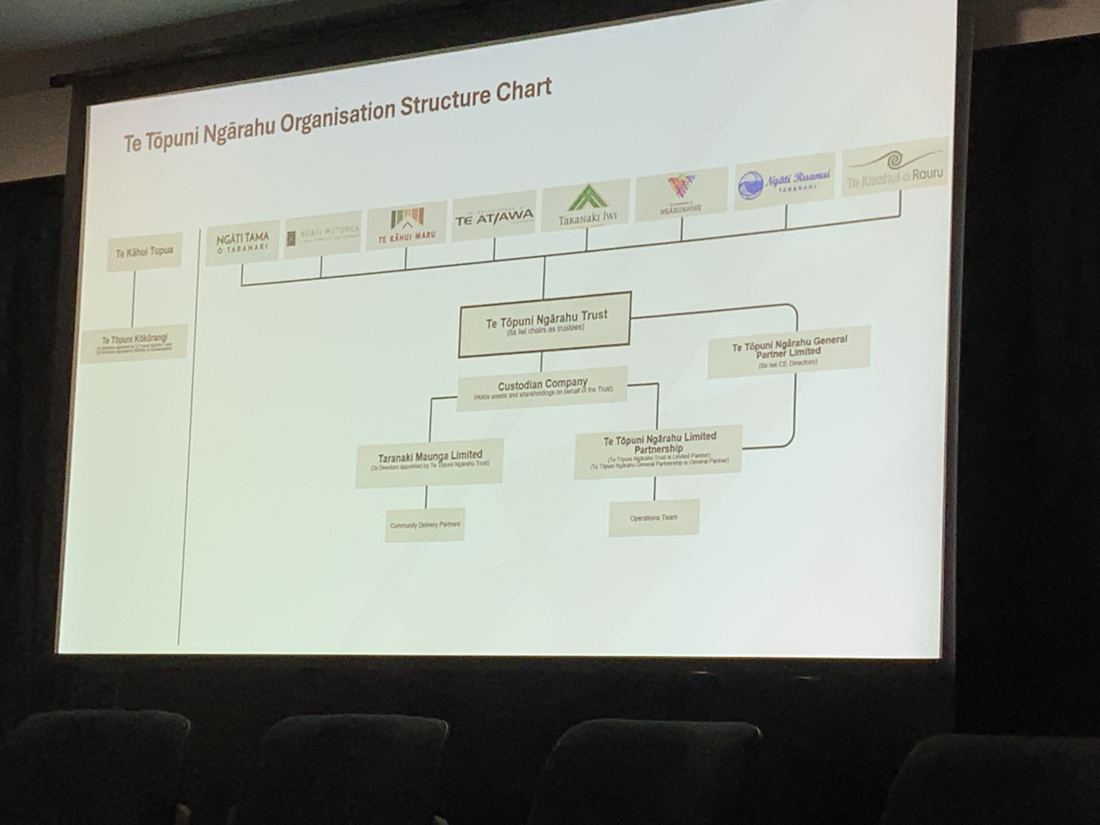
Te Tōpuni Ngārahu’s structure, as presented. The eight iwi across the top; the trust, custodian company and limited partnership beneath. Worth studying before you ask who to talk to — because the answer usually is not the entity at the top.
What we take from it
There is a version of this argument that treats partnership as the ethical garnish on a commercial one. It is the wrong version, and Joshu’s two declined consents demonstrate that it is factually wrong.
Here is the commercial version instead. The projects that failed at the regulator failed on evidence about environment and effects. The evidence that would have saved them is evidence that can only be gathered in partnership with the people who hold the knowledge and the standing. Therefore partnership is not adjacent to the consent. It is an input to it. A developer who treats it as overhead is under-investing in the single line item most likely to kill their project.
And there is a version of this argument that is simply about how the money moves. Sera's framing — relationships as the building blocks for de-risking large infrastructure investment — is the same argument Kate Daugherty from Westpac made about banks in the investment session, and the same argument Bridget Sullivan made about evidence for Wellington. Bring people in early or pay for it later. It is remarkable how many separate professions arrived at that conclusion independently in the course of one day.
ASL builds infrastructure that processes a community's waste and returns energy, biofertiliser and verified carbon reduction to that community. The three output streams only work if the loop closes locally, which means the benefit has to stay in the rohe. That is a commercial design constraint every bit as much as an ethical one — a plant that exports its value has broken its own business case as surely as it has broken faith with the people who host it.
We would much rather have the difficult conversation at the start than the expensive one at a hearing. If you are iwi, hapū or a landowner in a region where we are working, this is who we are — and this is how we are built and who we build with. The cup of tea is on us. Bread and jam optional.
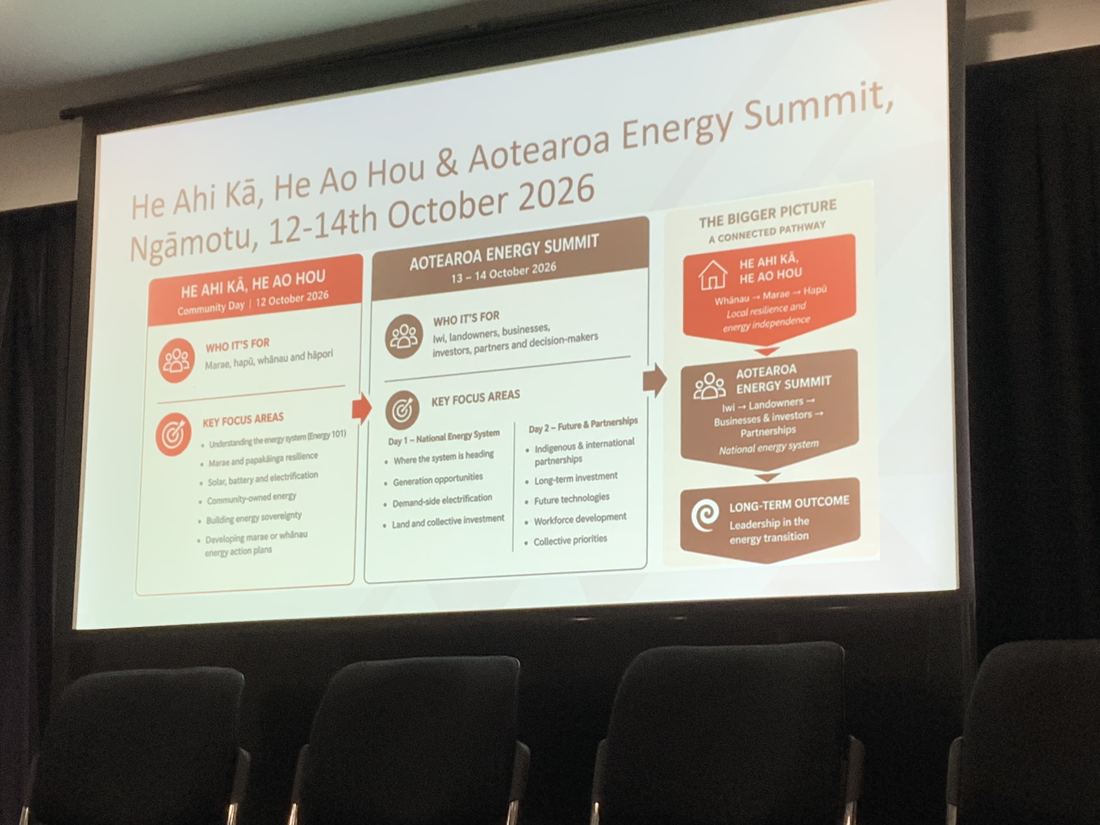
The invitation Sera Gibson extended from the stage. He Ahi Kā, He Ao Hou on 12 October is the community day — marae, hapū, whānau and hāpori. The Aotearoa Energy Summit follows on 13 and 14 October.
Ngā mihi nui to Wharehoka Wano, Sera Gibson and Dr Joshu Mountjoy for three presentations that belonged together more than the programme suggested, and to Jonathan Young for convening the forum. Sera also extended an open invitation to the Aotearoa Energy Summit in New Plymouth in October — community day on the twelfth, summit on the thirteenth and fourteenth. We will be there.
Taranaki Energy Futures Forum — the full series
Two Hundred People, One Room, and a Region Deciding What It Wants to Be
Nobody in That Room Was Short of Money. So Why Isn’t Anything Getting Built?
Taranaki’s Biogas Moment Has a Catch, and Almost Nobody in the Room Heard It
Two Declined Consents, and What They Should Have Taught New Zealand’s Energy Sector (this post)
We Swapped One Fuel for a Whole Toolbox, and That’s Why This Feels So Hard