
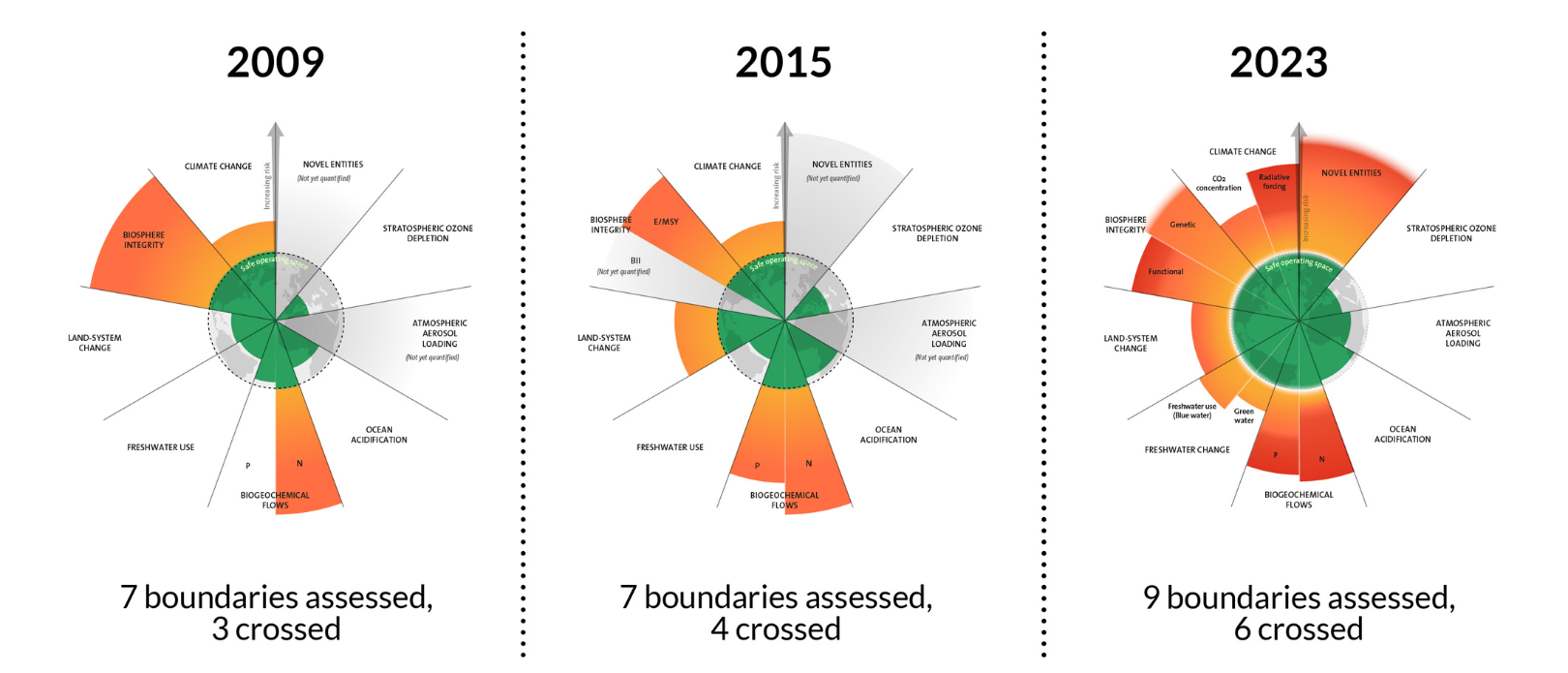
When talking about the environment, people often focus on carbon emissions. But our planet's health goes far beyond carbon, encompassing several interconnected boundaries. The concept of planetary boundaries helps provide a holistic view of our environmental impact. Introduced in 2009 and updated in 2015 and 2023, these boundaries highlight the safe operating space for humanity—if we exceed them, we risk catastrophic environmental degradation.
Yet, despite its importance, the idea of planetary boundaries is not as well known as it should be. Whenever I mention the term, the typical response is, "No, I haven't heard of that." But when I show them a visual representation of these boundaries, many say, "Oh, I've seen that!" This is why planetary boundaries must be part of the conversation—especially in presentations and educational materials. Showing how these boundaries have evolved from 2009 to 2023 is crucial to create a sense of urgency.[](https://www.stockholmresilience.org/research/planetary-boundaries.html)
However, focusing on the entire set of boundaries can sometimes overwhelm the audience. Instead, we can focus on the boundaries where we have explicit, powerful stories and solutions, particularly in the areas relevant to our work. Our messaging should focus on what we do well while connecting to the broader context of planetary boundaries.
Planetary Boundaries and Sustainable Waste Management
Here are six key planetary boundaries where our waste management solutions can make a tangible impact:
- Climate Change
Before: Picture a landfill emitting methane gas from decaying sludge and organic waste. The sky is polluted, and temperatures are rising.
After: A waste-to-energy facility processes organic waste and converts it into clean, renewable energy. The sky is clear, with no visible emissions.
[INSERT "After" Climate Change image here]
- Biogeochemical Flows (Nitrogen and Phosphorus)
Before: Mining activities extract chemical fertilisers, leading to environmental degradation and nutrient runoff polluting waterways.
[INSERT "Before" Biogeochemical Flows image here]
After: Our technology recovers nutrients from organic waste, reducing the need for mining and keeping waterways clean.
[INSERT "After" Biogeochemical Flows image here]
- Land-System Change
Before: A barren landscape where forests have been cleared for monoculture farming. The soil is dry, biodiversity is lost, and no animals are in sight.
[INSERT "Before" Land-System Change image here]
After: A thriving integrated farm system. Diverse crops, trees, and animals coexist, creating a balanced, biodiverse ecosystem.
[INSERT "After" Land-System Change image here]
- Freshwater Use
Before: The overuse of freshwater to manufacture synthetic fertilisers leads to runoff and effluent discharge, polluting waterways.
[INSERT "Before" Freshwater Use image here]
After: Our waste processing systems reduce water consumption by relying on natural fertilisers, resulting in cleaner water supplies and better water management practices.
[INSERT "After" Freshwater Use image here]
- Biodiversity Loss
Before: Soil microflora are destroyed by excessive chemical use, leading to barren land and reduced biodiversity.
[INSERT "Before" Biodiversity Loss image here]
After: Our systems restore healthy bacteria and fungi to the soil, fostering lush, biodiverse ecosystems.
[INSERT "After" Biodiversity Loss image here]
- Ocean Acidification
Before: Untreated effluent and chemical discharges into the ocean harm marine life, deplete fish stocks, and damage coral reefs.
[INSERT "Before" Ocean Acidification image here]
After: Effluent treated to high standards ensures that the ocean can support vibrant ecosystems.
[INSERT "After" Ocean Acidification image here]
Integrated Solutions: The Boundaries Impact Each Other
One of the key lessons from the planetary boundaries framework is that these environmental boundaries are interconnected. For example, addressing climate change through better waste management also improves ocean health and biodiversity. Our solutions are designed to recognise and respect these connections.
By using science-based metrics, we ensure that our approach is rigorous and transparent. We don’t just measure carbon (CO2 equivalent) emissions; we measure what truly matters across multiple dimensions, reducing the risk of greenwashing and providing a holistic view of environmental sustainability.
[INSERT planetary boundaries image (optional)]
Our focus is on the boundaries where we can make a real difference, showing that sustainability isn’t just about reducing emissions—it’s about addressing the complex, interconnected challenges facing our planet.
A Call to Action
By showing the evolution of planetary boundaries from 2009 to 2023, we create a clear sense of urgency. The time to act is now. We need to focus on solutions that address the most pressing environmental challenges and ensure that our actions positively impact more than just carbon emissions. Through our work, we demonstrate the power of integrating waste management solutions into a broader framework that respects planetary boundaries, helping create a healthier, more sustainable world.