Around the world, the evidence is becoming impossible to ignore: co-digestion of organic waste with sewage sludge isn't just promising — it's working. From prototype digesters at Chulalongkorn University in Thailand to fully operational municipal plants in Växjö, Sweden, the global landscape of waste-to-energy is advancing rapidly. In the United States alone, investment in new biogas systems grew by $3 billion in 2024 — a 40% increase and a new record — with roughly 200 agriculture and wastewater facilities already co-digesting food waste alongside manure or biosolids.
The momentum is real. But at Alimentary Systems, we keep coming back to a more grounded question: what does this mean for communities right here in Aotearoa?
Rooted in Aotearoa, Built for Aotearoa
Alimentary Systems was founded in New Zealand, and that's not incidental — it's central to everything we do. We understand the particular pressures facing councils and communities here: ageing wastewater infrastructure, rising landfill levies, emissions reduction targets under the ETS, and the persistent challenge of doing more with constrained ratepayer budgets.
We also understand the opportunity. New Zealand's organic waste streams — from municipal sewage sludge and household food scraps to dairy effluent and commercial kitchen grease — represent an enormous untapped energy resource. Research from Beca, Fonterra, and Firstgas has shown that wide-scale anaerobic digestion could produce between 13 and 17 petajoules of biogas energy per year in this country — enough renewable gas to supply every residential user and three-quarters of commercial gas users with carbon-free fuel.
Our Bioresource Recovery Plant (BRRP) technology is designed to unlock that potential — not as a distant promise, but as deployable, circular infrastructure that creates value from waste right now.
We Think Differently
The waste sector has no shortage of platforms and consultancies. What's rarer is a team that combines deep domain knowledge in anaerobic co-digestion with the engineering capability to design, build, and operate modular systems — and the intelligence layer to make those systems continuously smarter.
That's what sets Alimentary Systems apart. We're not simply building digesters. We're building intelligent systems.
Global research underscores why this matters. Prototype studies from Thailand have demonstrated that the optimal mixing ratio of food waste to sewage sludge can vary dramatically — from 7:1 in a two-stage digester configuration to 10:1 in a single-stage horizontal-shaft design. Laboratory trials on co-hydrothermal pretreatment combined with anaerobic sequencing batch reactors have pushed volatile solids removal efficiency from 61% to 77% over 300-day continuous experiments. Meanwhile, work on three-way co-digestion of sewage sludge, poultry litter, and food waste at 2:1:1 ratios is revealing new pathways for feedstock flexibility.

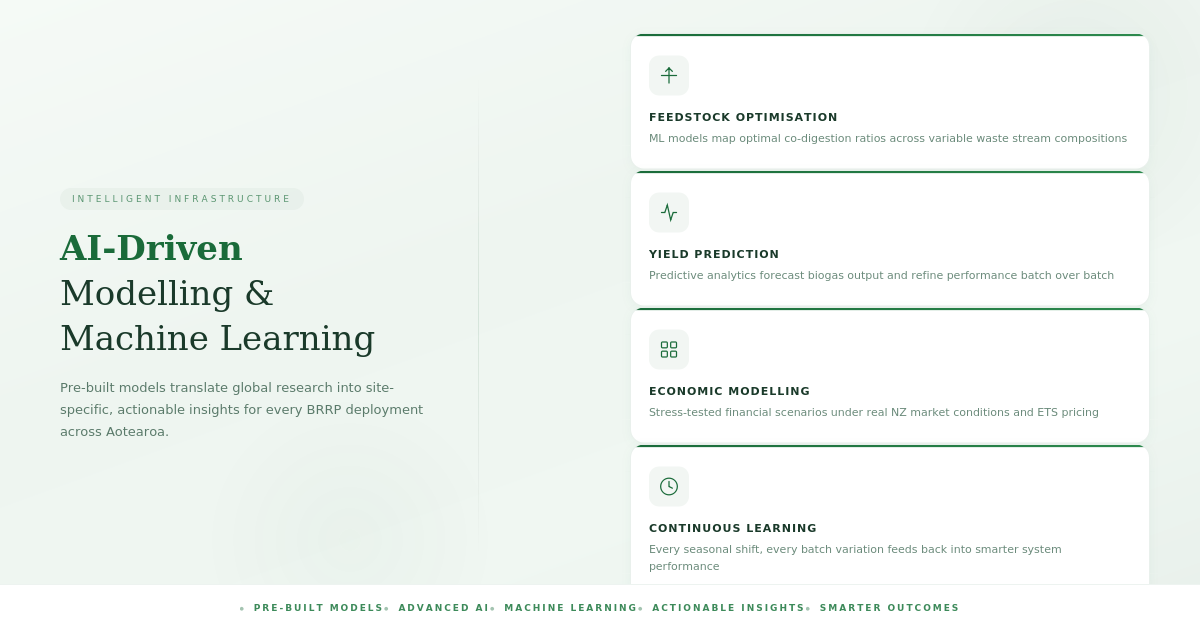
The science is rich — and it's highly sensitive to local conditions. That's precisely why we leverage pre-built modelling frameworks, advanced AI, and machine learning to translate this global body of research into site-specific, actionable insights. Before a single tonne of feedstock enters a BRRP, our models have already mapped the optimal co-digestion ratios for the available waste streams, predicted biogas yields across variable compositions, and stress-tested the economics under real-world New Zealand conditions.
Getting this wrong is expensive. Getting it right, with data-driven precision, is transformative.
Practical, Efficient, Truly Impactful
We share a common view with the communities and organisations we work alongside: solutions need to be practical. They need to work within existing constraints — regulatory, financial, spatial — and they need to deliver measurable outcomes.
The economic case for co-digestion is increasingly well-documented. Simulation modelling using tools like SuperPro Designer has demonstrated payback periods as short as 6.24 years with a return on investment of 16.23% and a positive net present value of $5.28 million for co-digestion facilities. Meanwhile, supply chain optimisation research using hybrid programming with system dynamics simulation is revealing how demand-oriented biogas supply models can further improve project viability.
Our BRRP model is built around this principle of economic circularity. It generates six distinct income streams — from bioenergy sales and gate fees to carbon credits and organic fertiliser — that offset capital costs within eight to ten years. That's a step change from legacy bioenergy infrastructure, which often requires thirty-year payback horizons. For councils and ratepayers, this means zero-waste and carbon-neutral targets become financially viable, not just aspirational.
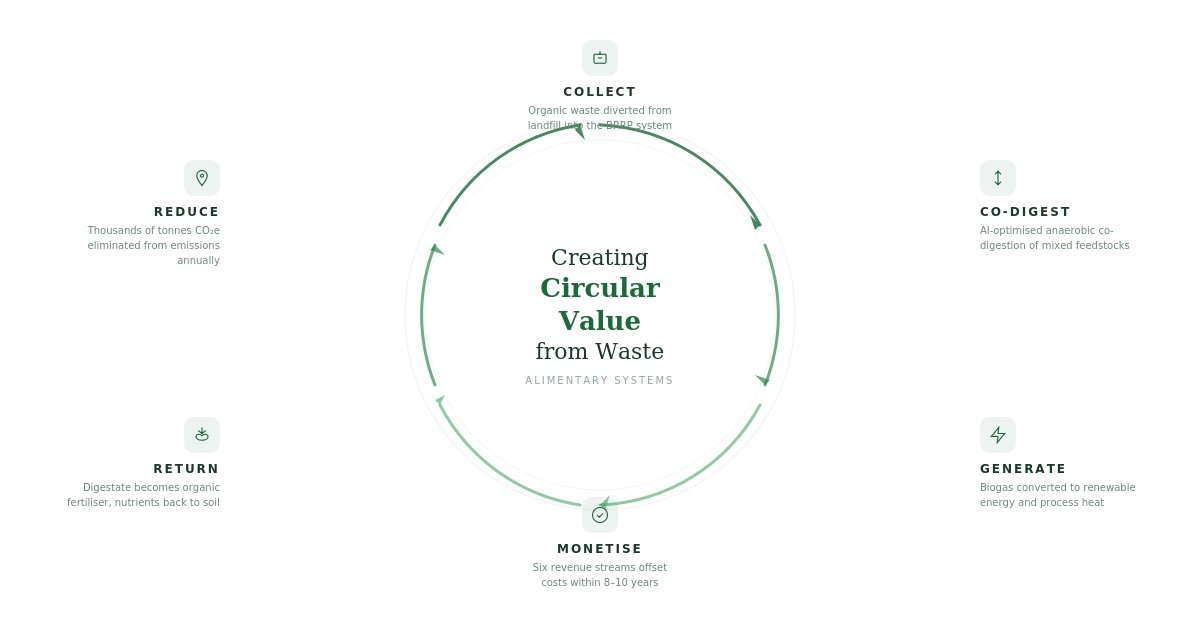
The environmental returns are equally compelling. By diverting organic waste from landfill and converting it into renewable energy, a single BRRP can eliminate thousands of tonnes of CO₂-equivalent emissions annually. The nutrient-rich digestate that remains becomes organic fertiliser, returning phosphorus and nitrogen to soils rather than waterways — closing the loop on nutrients that would otherwise be lost.
Innovation at the Intersection of Technology and Purpose
The global innovation pipeline in this space is accelerating. Thermophilic digestion at higher temperatures of 50–55°C is improving process speeds and pathogen destruction. Biochar is emerging as an excellent additive for enhancing anaerobic digestion, with its pore structure and cation exchange capacity enriching the microbial communities that drive gas production. In Europe, co-digestion plants in Sweden, Germany, and Switzerland are leading the way in upgrading biogas to vehicle-grade fuel. Greek wastewater treatment plants are boosting biogas output by between 14% and 674% simply by adding small amounts of agro-industrial by-products and food waste residues to existing sewage sludge processes.
At Alimentary Systems, we sit at the intersection of these global advances and local application. Our technology draws on the elegant efficiency of natural biological processes — anaerobic digestion is, after all, something nature has been running for billions of years. What we add is precision: machine learning models that learn from every batch, every feedstock variation, every seasonal shift, and continuously refine system performance.
This human-centred, technology-enhanced approach means our solutions aren't black boxes. They're transparent, adaptable, and designed to serve the people and communities who rely on them. Whether it's a regional council managing wastewater compliance, an industrial partner seeking to decarbonise process heat, or an investor looking for infrastructure with genuine impact, the system is built to serve real needs.
Looking Ahead
The numbers tell a clear story. The U.S. EPA estimates potential for over 8,000 livestock biogas systems that could generate more than 13 million megawatt-hours of energy annually. U.S. biogas production grew by over 10% in 2024, and the food waste sector alone has 16 new co-digestion projects under construction for 2025. Globally, the integration of AI, predictive modelling, and supply chain optimisation is making these systems smarter, more efficient, and more financially attractive with every passing year.
Alimentary Systems is positioned at the leading edge of this transition — not by chasing global trends, but by solving local problems with world-class intelligence. As we continue to refine our AI-driven modelling, expand our BRRP deployments, and deepen partnerships across Aotearoa, our mission remains unchanged: to convert a waste liability into renewable infrastructure, and to prove that the smartest solutions are also the most practical ones.
The future of waste isn't waste at all. It's energy, it's fertiliser, it's carbon credits, and it's cleaner communities. And it starts here, in Aotearoa.
Alimentary Systems is a New Zealand-based circular infrastructure company building intelligent Bioenergy Resource Recovery Plants. To learn more or explore investment opportunities, Contact us to use AI modelling in solving your waste problems.